Visit us with your loco
Requirements
For those who wish to bring a locomotive to run it is mandatory to bring with them a certificate of Public Liability Insurance which is usually available from their own club free of charge, and their club membership card. Steam locomotives should have current boiler certification for both hydraulic and steam tests.
If hauling public then a spark arrestor or deflector is required.
Out of courtesy, please contact us before visiting by emailing trains@kdmes.org.uk.
Remember to bring:
Available Facilities
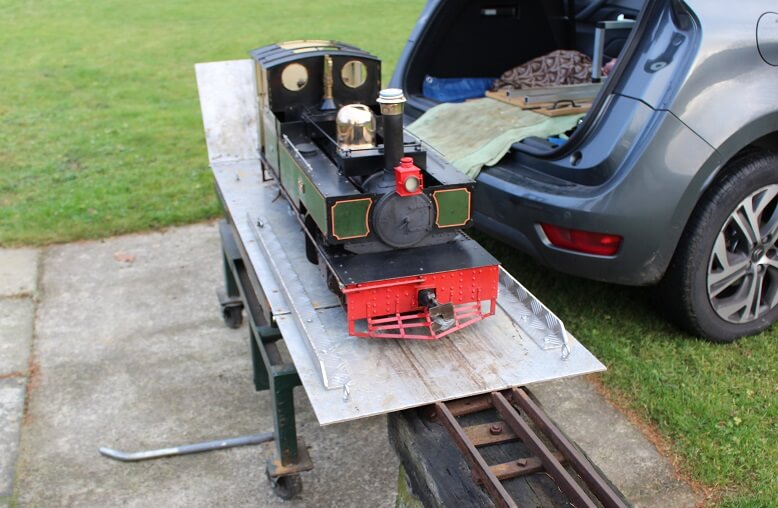
To unload there's a hydraulic lifting table with 500 kg capacity. 153cm in length, 35cm width and a minimum loading height off the ground of 45cm. The lift can be rotated 360°.
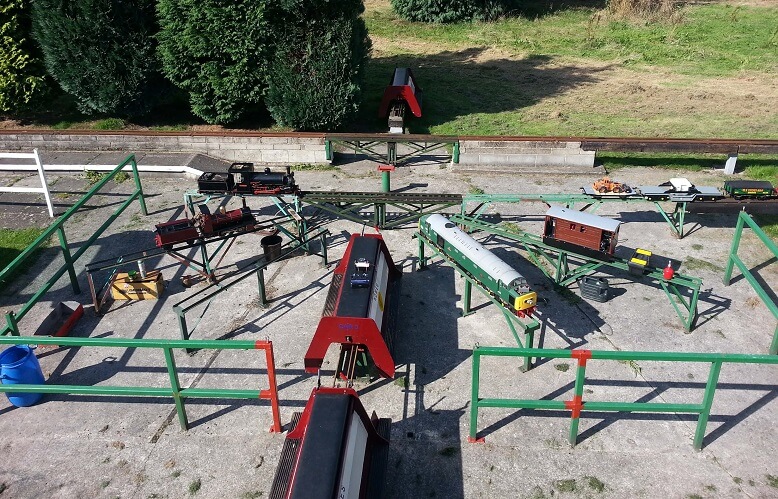
The turntables in the steaming bay are 215cm long.
Our steaming bay is equipped with 12v dc power, compressed air and a supply of clean rain water.
All ash must only be disposed of into the tray in the steaming area. Petrol/diesel refuelling is not permitted in the steaming bays if other steamers are in operation and only permitted when fire extinguishers are deployed.
Coal (Beans and grains) is available but visitors are required to supply their own lubricating oils.

Track and Signalling
The track is a 3½" and 5" dual gauge raised track. It's approx 350m in an oval with 60m minimum radius curves. Signals must be observed when operational.
With the exception of one manually operated set of signals, all signalling is automatic. The automatic signalling is based upon standard Network Rail ‘Block signalling’ practice where a train is only permitted to enter a ‘block section’ under a green aspect denoting that the section ahead is clear. Once a train enters that section, the aspect behind the train changes to show a red aspect which only returns to green when the train leaves the section and enters the next. All automatic signals are of the two aspect type showing either a green or red aspect.
The exceptions are:-- Signal numbered S7M which is manually operated by switches mounted adjacent to the signal head and is interlocked with the motorised turntable.
Signal S7M is a two aspect signal showing either a red or yellow aspect. Under normal operating conditions, an yellow aspect is shown and is only changed to red when turntable is moved from its straight through position. Under no circumstances should this signal be passed when the red aspect is displayed. When the yellow ‘caution’ aspect is lit, the train can enter the station limits but at a reduced speed and be prepared to stop if the platform is already occupied by a train or if the station controller requires you to stop.
Once the train in front has cleared the station limits, you must wait until signal S1A / S1A(R) shows a green aspect before proceeding. Where passengers have been loaded on to the train, the station controller will also instruct you when you can draw forward to signal S1A.
For sighting purposes, Signal S1A has a duplicate repeater signal mounted on the bridge at high level.
- Signal numbered S4D is a two aspect distant signal for signal numbered S4A which shows either a yellow or green aspect. When signal S4D shows a yellow aspect, you must pass at a reduced speed and be prepared to stop at signal S4A which may be showing a red aspect. If signal S4D is showing a green aspect, this can be pased at line speed as signal S4A will be showing a green aspect.
It is important to stress that the driver whilst running under signalled conditions must be prepared to stop in an emergency should a preceding train come to a stop.